

Improving Access to Healthcare in Wilmington
A significant portion of Wilmington, NC residents struggle getting access to affordable, quality healthcare, with some neighborhoods having uninsured rates as high as 28 percent, according to 2020 American Community Survey estimates. In 2021, the Novant Health network announced a major gift from Wilmington native Michael Jordan to fund two new community clinics in New Hanover County and help address this inequity. Novant then collaborated with Cape Fear Collective (CFC) at each stage of an analysis to help determine the location of the new clinics. Their partnership provides an example for other health systems on combining data and engagement to ensure investments maximize benefit to residents.
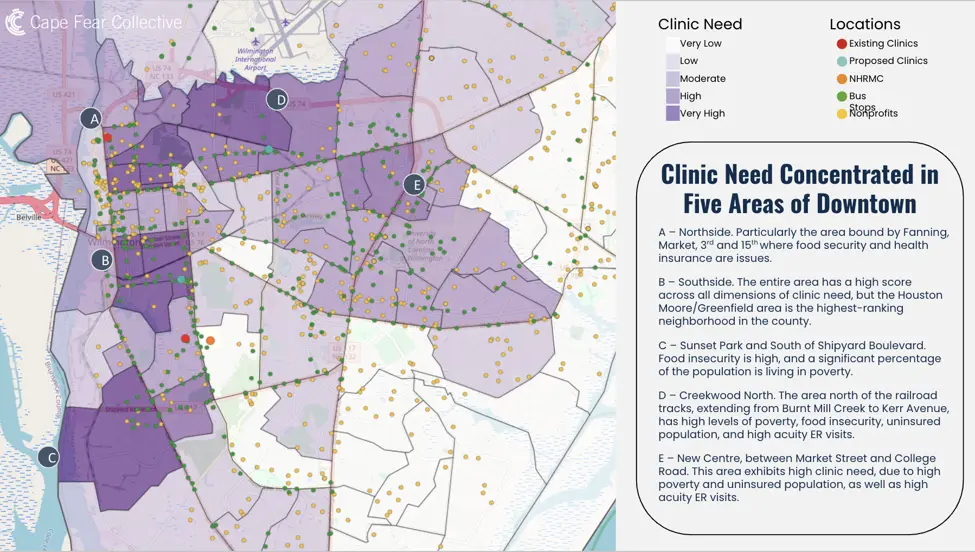
Cape Fear Collective developed the Clinic Need Index (CNI) as the backbone of the analysis to produce a measure of healthcare need on a scale of 0 to 1. The index combined two indicators from Novant’s clinical emergency room data with other indicators, such as uninsurance rates, poverty, access to transportation, and food security. By centering around the social determinants that drive healthcare access, the CNI reinforced a more complete understanding of which populations don’t get the care they need and why.
The analysis went beyond only levels of need, however. Novant wanted to ensure the clinics would be seen as true “neighborhood” clinics rather than ones organized solely around providing healthcare. The success of this approach required community partners to collaborate with and serve residents holistically. To represent this context, CFC overlaid a map of Wilmington with neighborhood services like community groups, healthcare facilities, grocery stores, and pharmacies. Data showing areas with both high need and strong neighborhood assets highlighted candidates for the most impactful locations for the new clinics.
CFC also helped identify an improved geographic level for the selection process. While Novant had normally viewed data at the ZIP code level, the CNI revealed a more localized picture by calculating the CNI for each census block in New Hanover County. To make the information more digestible for decisionmaking, they then aggregated the block-level calculations into scores at the census tract level. This smaller scale proved crucial for identifying characteristics that an analysis at larger geographies may have missed. For example, the New Hanover Medical Center is in a relatively affluent ZIP code, but the tract-level data identified that part of the ZIP Code was one of the highest-need and most underserved areas.
After reviewing the spatial analysis centered around the CNI, Novant and CFC held interactive sessions with health professionals, local advocates, and residents to ground-truth the data and hear community perspectives. This engagement also demonstrated to the local community that Novant was being thoughtful about locating the clinics. The conversations surfaced a concern that the new clinic would compete for patients from free Federally Qualified Health Centers (FQHCs). Novant used the data CFC prepared to show that the new clinics would instead serve new groups of people without overlapping with existing FQHC service areas. During the meetings, CFC provided historical Community Health Needs Assessment data to demonstrate that access to healthcare was a consistent resident concern. Both the data and historical context helped convince residents at community meetings that Novant was making decisions that put community needs and priorities first.
The two clinics opened in 2024 and 2025, respectively, in neighborhoods with the highest levels of need in Wilmington. While not a factor in the decision-making, the two areas also had disproportionately high shares of Black and Hispanic people. In a city where residents’ neighborhoods heavily drive their access to healthcare, the investment into these clinics is a meaningful step toward addressing inequities in Wilmington and serving the residents that need the services most.
The impact of CFC’s work on this project extended beyond the clinics themselves to help shift Novant’s decision-making processes to consider community conditions more often. For example, Novant’s Director of Community Health, Sarah Arthur, said that Novant’s construction and design team went from focusing solely on the cost of real estate when selecting site locations to incorporating resident needs and neighborhood assets. She also stated the experience reinforced the need to incorporate social determinants of health into Novant’s planning and health care services.
The collaboration between Cape Fear Collective and Novant illustrates how keeping equity at the center, leveraging rigorous and multifaceted analysis, and listening to the local community leads to better decisions in the short-term and ultimately to a healthier community.
This article was written by Cole Campbell at the Urban Institute. We would like to thank Tom Gomes, Cape Fear Collective’s Associate Director of Strategic Partnerships, and Sarah Arthur, Novant’s Director of Community Health for contributing information about their collaboration. Cape Fear Collective is the NNIP Partner representing Wilmington, North Carolina.