
Quantifying the Stakes of Policy Changes for Connecticut Communities
Policy debates often involve high-level considerations: benefit levels, eligibility rules, funding models, and projected costs. But the people and communities affected by those policies need answers to more locally focused questions: How many families in my town would benefit? How many people could lose assistance? What would this mean for children in my neighborhood or residents in my legislative district?
For Lisa Tepper Bates, president and CEO of United Way of Connecticut, answering those local questions can change the way policymakers and communities understand a proposal. In her experience, many policy proposals struggle to gain traction because they are, as she describes, “too wonky” and disconnected from people’s experience. Legislators may also make decisions based on their own assumptions about how a policy will affect their constituents.
DataHaven, the National Neighborhood Indicator Partnership’s New Haven, Connecticut, partner, developed an innovative way to provide meaningful information about who is affected by policies. In collaboration with local organizations and leaders like United Way of Connecticut and Tepper Bates, they’ve developed a series of “Mapping Local Impact” reports that translate complex policy changes into concrete numbers for Connecticut communities.
The approach combines rigorous statistical analysis with interactive maps and localized factsheets to help answer the question: What would this policy mean here? Using US Census Bureau American Community Survey microdata analyses, DataHaven’s methodology allows them to estimate the economic and social effects of proposed policies at multiple geographic scales, including individual towns, state House districts, and United Way service regions. And by disaggregating the data by race and ethnicity, income, household and family type, and immigration status, DataHaven can also illuminate whether policy changes are expected to result in disparate impacts.
How Many Families Could Benefit from a Connecticut Child Tax Credit?
Instead of asking policymakers to guess what the 2024 proposal for a $306 million Connecticut Child Tax Credit (CTC) might mean for their constituents, DataHaven delivered concrete estimates about how many families would be affected by the proposed policy. Their analysis estimated that the CTC would reach 268,000 families and that 88 percent of Black children and 91 percent of Latino children in Connecticut would benefit from the proposed credit. These statistics were the most frequently cited figures in public hearings and advocacy testimony for the CTC.
In partnership with United Way of Connecticut and She Leads Justice, a local advocacy organization focused on single parents, DataHaven created public interactive maps that displayed projected benefits by town and legislative district and developed fact sheets for a range of geographies including all towns, all state legislative districts, and 15 local United Way regions. DataHaven further translated this research to coproduce materials and templates that were used by hundreds of residents and advocates to give public testimony in support of the bill.
“Our partnership puts data and research into the hands of dozens of nonprofit organizations and hundreds of Connecticut families working to pass this critical piece of legislation. These data tools are indispensable in identifying inequities, guiding effective policy solutions, and supporting advocacy to improve the lives of Connecticut residents.”
—Lisa Tepper Bates, President and CEO of United Way of Connecticut
Although this CTC proposal was not enacted in 2024, Connecticut did enact a more modest expansion of the state Earned Income Tax Credit in 2026 and advocacy for a fully refundable Child Tax Credit continues.
What Do Shifts in Federal Policies Actually Mean for Communities?
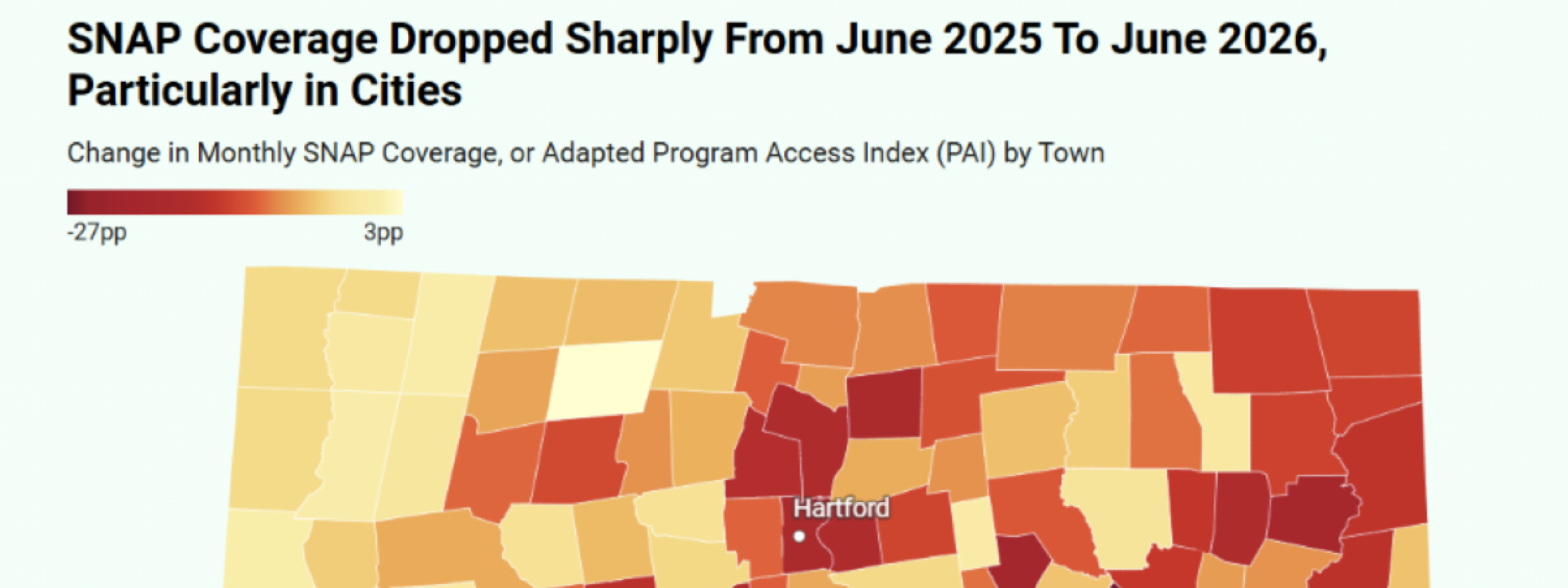
In response to sweeping federal policy changes in 2025, DataHaven adapted the approach they used to analyze the 2024 CTC proposal and worked with community partners to develop a new series of Mapping Local Impact reports to estimate the local consequences of proposed federal changes to the Supplemental Nutrition Assistance Program (SNAP), Medicaid and health insurance, tax relief, and homelessness prevention.
In addition to using American Community Survey data and data from state agencies and nonprofits, these reports used data from the DataHaven Community Wellbeing Survey, which draws on interviews with more than 53,000 randomly selected adults across every ZIP code in the state to produce reliable local data and detailed insights into residents’ life experiences. The survey was updated in 2025 to include questions on SNAP, Medicaid, and housing and immigration enforcement, providing insights into what residents were experiencing before and during policy changes.
The resulting reports translated national policy debates so that residents, elected officials, and community organizations could understand the impact of federal shifts and work to alleviate resulting harm.
- Local United Ways across the state and two state representatives cited DataHaven’s estimate that 58,000families lost significant SNAP benefits in their announcement of a statewide emergency grocery-assistance program.
- DataHaven’s estimates of the local impact of changes to SNAP and the loss of enhanced federal tax credits for those with Affordable Care Act coverage informed the allocations for food and health care assistance from a $500 million state fund.
By mapping the local impacts of a range of federal and state policies, DataHaven and their partners’ work shows how these issues intersect and illustrates how decisions made at the state or federal level can add up to major changes in the economic security of a community. For example, looking across these reports for the town of Waterbury, Connecticut, shows that the proposed 2024 CTC would have provided an estimated $14 million annually to 12,317 households. However, this policy did not pass, and the 2025 policy changes meant that the town could lose $13 million in SNAP benefits, 11,000 residents could lose Medicaid coverage, and 395 people could be at risk of losing permanent supportive housing.
Partnerships Between Local Data Organizations and Community Groups
DataHaven’s partnership model for the Mapping Local Impact reports is a compelling example of how community data organizations can approach partnerships with advocates and community groups. DataHaven’s deep local knowledge, relationships, and technical expertise enables them to develop analyses that are trusted by their collaborators. By working with local partners, DataHaven’s estimates are accurately contextualized and shaped by the experiences of affected communities. By coproducing interactive maps, local factsheets, and advocacy materials, DataHaven and its partners turn complex policy analysis into information that residents, advocates, community organizations, and policymakers can readily understand and use.
“DataHaven ensures we have the data that we need—and that we are not just collecting it as an exercise but rather producing a report that is meaningful and actionable and responsive to our communities.”
—Yvette Highsmith, vice president, Community Health Center of Middletown
When policy analysis is separated from community context, it can be easy to lose sight of what legislation, budgets, and program changes mean for people’s everyday lives. Initiatives like Mapping Local Impact help bridge that gap by connecting rigorous data with local knowledge and residents’ experiences and create a stronger foundation for evidence-based decisionmaking.
This article was written by Gabi Velasco at the Urban Institute. We would like to thank Mark Abraham, Executive Director of DataHaven, Lisa Tepper-Bates, President and CEO of United Way of Connecticut, and Yvette Highsmith, vice president Community Health Center of Middletown for contributing information about their collaboration. DataHaven is the NNIP Partner representing New Haven, Connecticut.